Published October 15, 2021 01:36AM
Use Trail Running To Get Fit For Big Mountain Objectives
Legs are the main propulsion you have in the mountains, and their large muscle mass requires special attention.
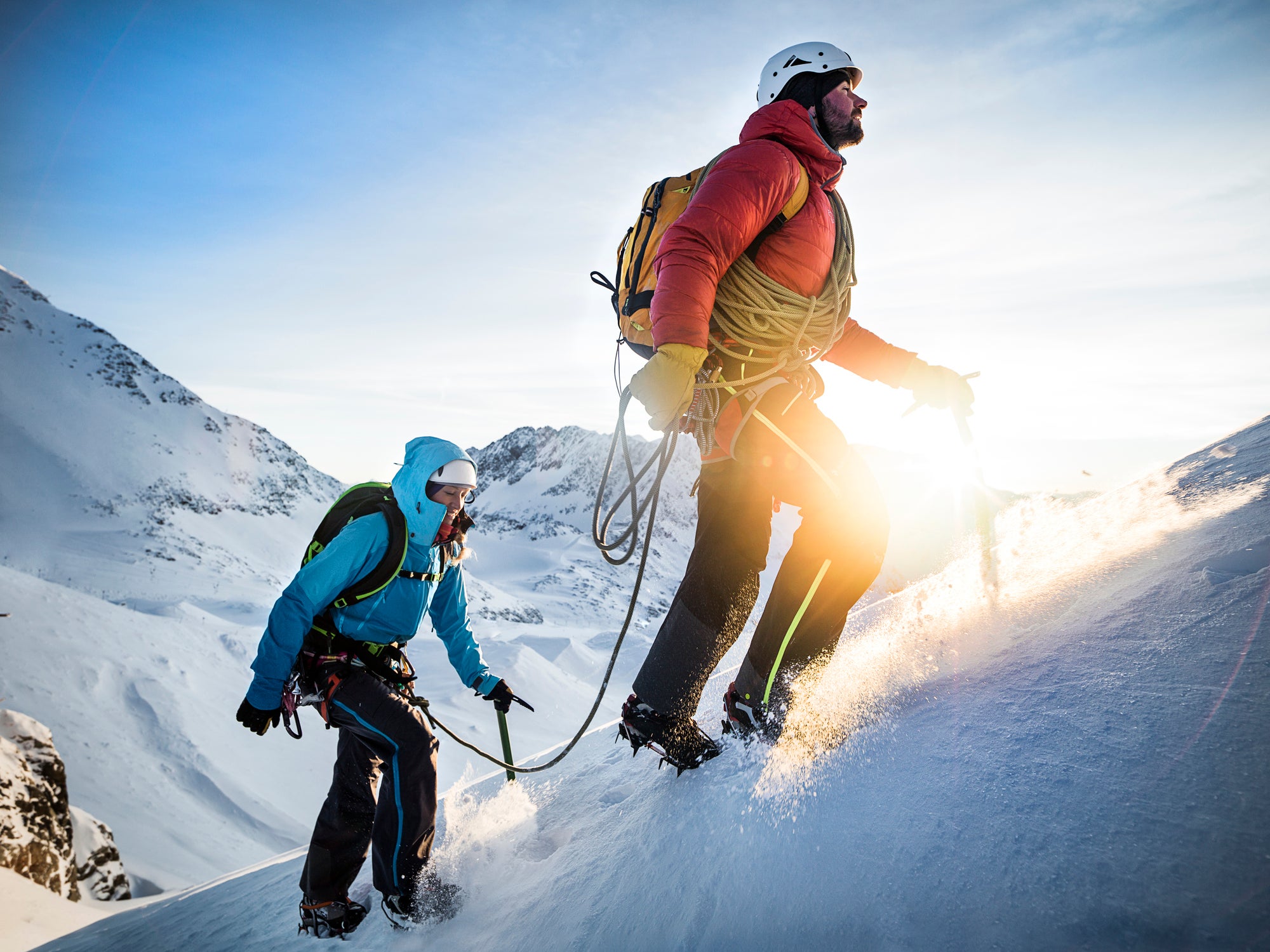
Mountain climber leading up a snowy ridge at sunrise.
A Training Plan for Alpine Climbing
You might train your upper body endlessly for the demands of technical climbing, but getting to intense backcountry objectives demands a base strength in your lower body as well. Legs are the main propulsion you have in the mountains, and their large muscle mass requires special attention. We’ve developed a solid, structured training program that will help you build the necessary strength and endurance to achieve your goals, keeping you healthy and energized when you set off from high camp.
This base training period includes two specific exercises that will improve your fatigue resistance, so you can handle more intense climbs—even after you’ve hiked several hours with a weighty pack. Do hill sprints first because they allow you to build maximum leg strength and power before getting into weighted hill climbs, which simulate the endurance needed for ascending moderate to steep alpine terrain.
ADVERTISEMENT
RELATED: The Awkward Thrill Of Running Up Ski Slopes
Hill Sprints
Find a steep (20 to 50 percent incline, steeper is better) hill with decent footing so you can sprint and are not dodging roots and rocks; stadium stairs are also a great option. A steep incline increases the workload on legs and hips without the impact or increased training time it would take to achieve the same benefit through running on flat terrain. Although hill sprints would normally fall under the category of power training, which emphasizes speed and explosiveness, they also offer dramatic benefits in pure leg strength. This exercise is simple, effective, specific, and best of all, highly portable—especially if you don’t have a gym.
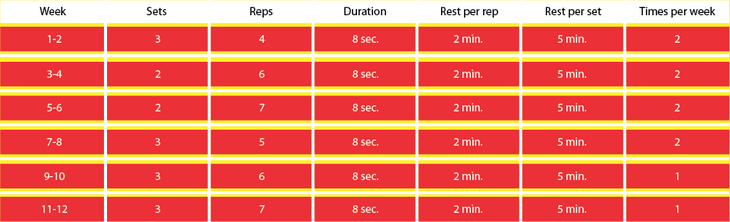
- Do this twice a week until the last few weeks to increase amount of resting time.
- Make sure where you’re sprinting has good, solid footing; slow, cautious steps will not achieve the desired effect.
- Focus on speed of movement and explosiveness on the way up, and then walk back down.
- Stop the set when you feel your power drop.
- Each sprint should be no more than 10 seconds.
RELATED: The Science And Theory About Training For Steep Trails
If You Don’t Have a Hill…
Engage a few friends to push a car back and forth in a parking lot. Put it in neutral, and make sure you have quick access to the brake. As you push one way, your friend pushes the other, so it’s not really moving that much. Push on the front and rear bumpers so that you can really lean into it and get your big leg muscles involved. Take a few minutes of rest between short pushes of six to 10 seconds and you’ll see amazing results in leg strength.
- Find a stadium and use the stairs.
- Attach a tire to a harness with webbing and biners and drag it on a less steep hill or flat ground for up to a minute. Repeat that as you would each sprint.
- Some gyms may have steel sleds onto which you can stack weight. You can then push the sled up and down a paved alley or across a grass sports field.
ADVERTISEMENT
Weighted Hill Climbs
The goal of this phase is to increase how long your muscles can operate at a high percentage of max strength, which improves your endurance. Do this after completing 12 weeks of hill sprints, and plan on finishing at least two weeks before your objective. This stuff is going to make your legs very tired, and you will not be at your best until you have a good recovery period. If your performance improves for the first couple of weeks, but then plateaus and drops off, you are doing too much and should drop down to one session per week. Jugs of water are good to carry because you can pour them out at the top of the hill without trashing your knees with the extra weight on the way down. If you’re lacking a handy stream, you can carry rocks and dump them out at the top. Just bring extra padding for your back.
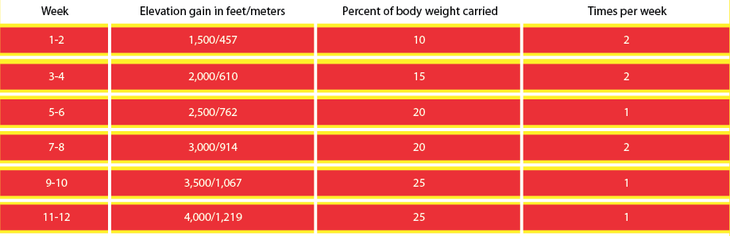
- Do two sessions a week (72 hours between each), unless you’re getting out and hiking with a pack on the weekends, and then only do one.
- Wear boots similar to what you’ll wear on your climb, not running shoes.
- Breathe through your nose; you should still be able to maintain a conversation. The goal is to have fatigue in your legs at a relatively low heart rate. If you are able to hike fast enough to get short of breath, you need to add more weight or pick a steeper hill.
- The steeper the better for the hill; a scree field or uneven ski slope is better than a flat trail.
- To get the desired amount of vertical feet, you might need to do multiple laps.
- If your legs are already well-conditioned, start with 20 to 25 percent of your body weight.
- The speed and weight of the climb should be limited by your legs, not by your breathing.
- A gallon of water weighs eight pounds; one quart weighs two pounds.
Vertically Impaired?
So, you’re in North Dakota and the highest thing within 150 miles is a hay barn. It can be very effective to do this type of weighted workout using only a 12-inch box to step up and down. The boredom factor may become extreme, so you may want to arrange a source of entertainment, but it’s easy to control the intensity and overall quantity of the training.
ADVERTISEMENT
Steve House is an IFMGA-certified mountain guide, and he has completed many notable climbs throughout the Alaska Range, the Karakorum in Pakistan, and the Canadian Rockies. He serves as an alpine mentor, promoting alpinism by coaching and encouraging young up-and-coming alpinists.
Scott Johnston grew up in Boulder, Colorado, and was quickly recognized for his impressive cardiovascular endurance, which he utilized when competing in World Cups for Nordic ski racing. Johnston currently lives in Mazama, Washington, where he continues to ski and climb.